 LYNXSPACE
Programme · High power rocket
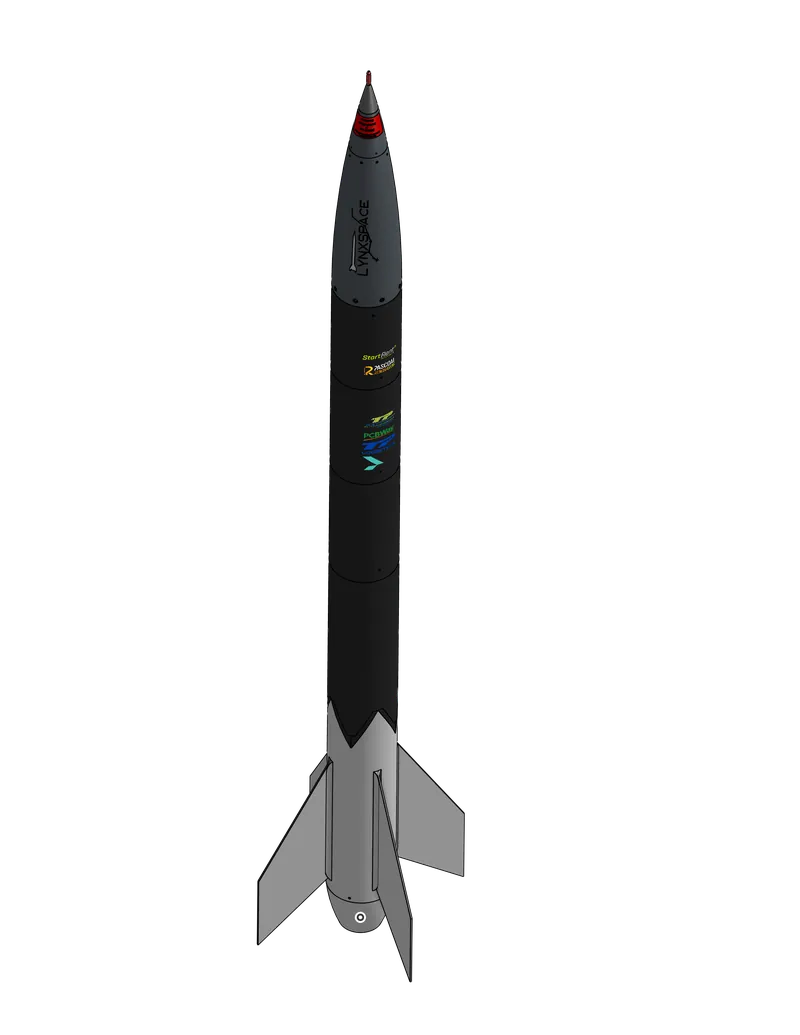
LYNXROCKET V5
Experimental launch vehicle designed for iterative mission testing, data collection and avionics reliability across flight campaigns.
| Class | Experimental sounding rocket |
|---|---|
| Propulsion | Solid, M impulse |
| Recovery | Dual-deploy parachute |
| Completed | Bench and ground test series |
| Next | Flight Campaign Alpha, Q3–Q4 2026 |
- Target apogee
- 3 000m AGL
- Predicted max speed
- ~Mach 1.2
- Predicted peak thrust
- ~3 000N
- Predicted burn time
- ~3s
Programme
Supersonic Rocket
V1 to V4 were static engineering prototypes: airframes built to develop structure, avionics and aerodynamics on the ground, never flown. V5 carries their changes and is the first of the series built to fly. The programme is built to return data rather than altitude records: data quality, safe recovery and post-flight analysis come before the number on the altimeter.
Reference sheet
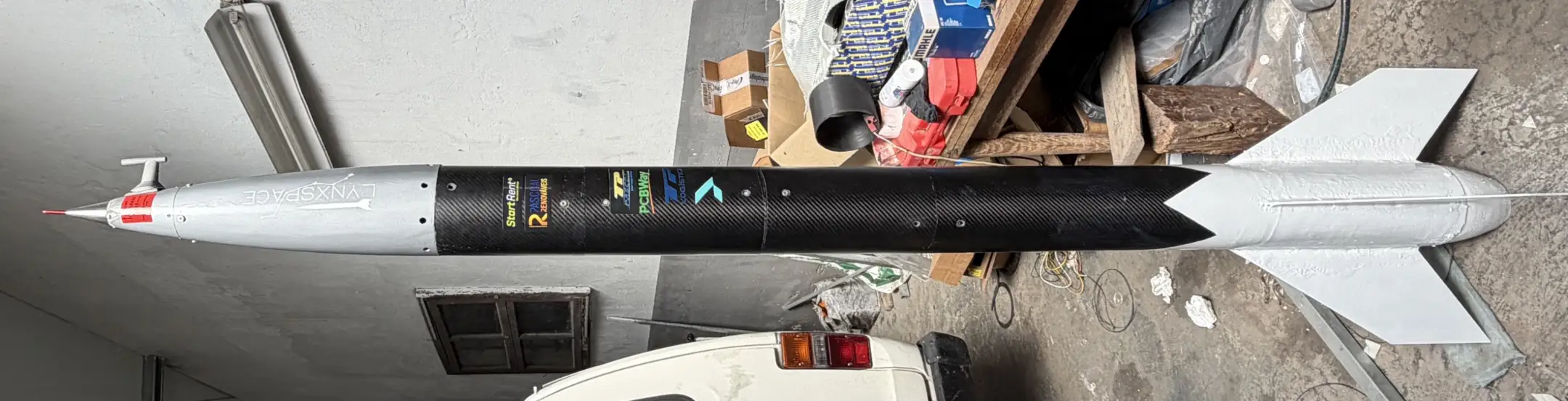
Lynxrocket V5 specification
| Total length | 2.4 m |
|---|---|
| Diameter | 140 mm |
| Dry mass | 9 kg |
| Body and fins | Carbon fibre |
| Nose cone | Ogive, fibreglass layup |
| Flight computer | LynxYNav V6.1, STM32H563RIT6 |
|---|---|
| Sensors | Dual IMU, barometer, GNSS |
| Telemetry | 868 MHz LoRa downlink |
| Logging | 16 MB flash at 50 Hz |
| Events | 3 pyro channels, dual-deploy with main backup |
| Stage 1 | Drogue at apogee |
|---|---|
| Stage 2 | Main chute at ~300 m AGL |
| Deployment | Electrically fired charges |
| Backup | Telemetry-based redundancy |
| Parameter | Design target | Flight-measured |
|---|---|---|
| Motor class | M impulse range | Not yet flown |
| Burn time | ~3 s | Not yet flown |
| Peak thrust | ~3 000 N | Not yet flown |
| Apogee | 3 000 m AGL | Not yet flown |
| Max velocity | ~Mach 1.2 | Not yet flown |
| Landing speed | ~5 m/s | Not yet flown |
The empty column is deliberate. It fills in with post-flight telemetry after Flight Campaign Alpha; until then there is nothing honest to put in it.
Flight profile
Nominal sequence
- T+0
Ignition
Solid motor in the M impulse range.
- T+~3 s
Burnout
Motor burns out and the vehicle coasts, having passed a predicted ~Mach 1.2.
- Apogee
Drogue deploy
Target 3 000 m AGL. Drogue charge fired electrically at the apogee event.
- ~300 m AGL
Main deploy
Main canopy, with telemetry-based redundancy behind the primary event.
- Touchdown
Landing
Predicted ~5 m/s under the main canopy.
Campaign
V5 mission timeline
- Q1 2026Complete
Avionics bench validation
Hardware-in-the-loop testing of the LynxYNav V6.1 board, sensor fusion calibration and communication stress tests.
- Q2 2026Complete
Ground test series
Recovery deployment drills and a full dress rehearsal with integrated avionics.
- Q3–Q4 2026Next
Flight Campaign Alpha
First V5 flights: telemetry validation, recovery consistency and airframe stress data. The first measured figures come from here.
- LaterPlanned
Full payload campaign
Scientific payloads flown for companies and partners.
Contact
Fly something with us
The full payload campaign carries scientific payloads for companies and partners. Tell us what you need to measure and at what altitude.